
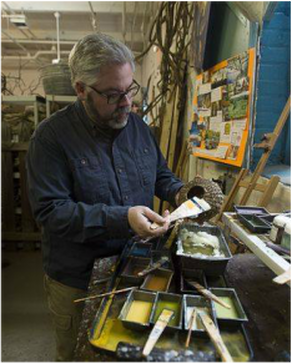
Sculptural Basketmaker and Encaustic Artist Matt Tommey adds encaustic medium to his kudzu baskets.
|
What is Encaustic Art?Encaustic painting is an ancient painting technique which combines beeswax, damar resin and then either oil paint or natural powdered pigments to give it color.
Encaustic wax is a hot wax method where the medium (beeswax and resin) is heated to around 170 degrees Fahrenheit, and then color is added to make a hot paint. In paintings, artists typically paint on wood or canvas. Encaustic is primarily composed of two main components - natural beeswax and damar resin, which is a crystallized tree sap. These ingredients form the basis of the encaustic medium. When used alone, encaustic can showcase its inherent qualities of transparency and adhesive properties. Additionally, the medium has the capability of being pigmented. Artists have the option to either add pigments to the encaustic medium themselves or purchase pre-colored encaustic mediums that already contain traditional artist pigments. In my work as a sculptural basketry artist, I paint the encaustic wax directly on my baskets to create a unique surface treatment. I am honored to have one of my encaustic wax sculptures included in the permanent collection of the Museum of Encaustic Art. |
Using Encaustic Wax in Sculptural Basketry & Woven Sculpture
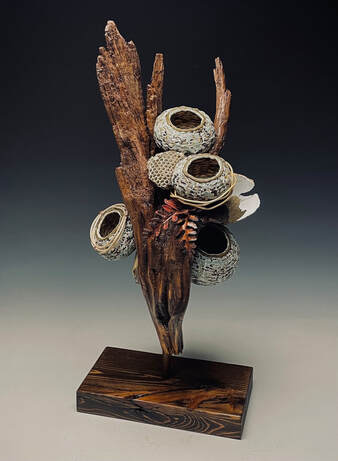
I started experimenting with encaustic wax within my basketry work back in 2011. My friend, encaustic painter Julia Fosson was kind enough to share some basic information about using encaustic wax in my art and armed with enough knowledge to be dangerous I launched into my encaustic art journey.
I use encaustic wax in two different ways: preservative and decorative. First, I use the clear medium as a preservative on almost all my work by infusing it into the natural fibers after I create a piece. This has proven to be a very successful way of preserving my baskets, adding rigidity, making them water resistant, and easier to clean. To achieve this, I rely on a range of essential tools and supplies that are crucial for working in encaustics. These include a Hot Plate/Electric Griddle for heating the wax, a heat gun for melting and manipulating the wax, and pigments and/or oil paints for adding color and depth to my creations.
In addition to the aforementioned tools, I make use of refined beeswax and natural beeswax, which serve as the base materials for my encaustic medium. I also incorporate Damar Resin or pre-made Encaustic Medium, which combines wax and resin, providing a ready-to-use solution. To further enhance my artwork, I sometimes use Encaustic Paints and Encaustic Gesso, which provide additional texture and surface treatments.
As for the application process, I utilize bristle brushes for smooth and controlled strokes. I've also used woody crayons or artist crayons for adding intricate details. When working with resin, I find a rubber mallet to be useful for breaking it up into smaller pieces. Metal tins serve as containers for storing and mixing the wax, while sticks, chopsticks, and toothpicks enable me to manipulate the hot wax during the creative process. A metal potter's rib and other random tools also come in handy for experimenting with different techniques.
To ensure safety and protection while working with encaustic wax, I always wear gloves and use pot holders to handle hot materials. Additionally, a respirator or ventilation system is essential to prevent inhalation of fumes. It's a good idea to keep burn cream and aloe gel readily available in case of any accidental burns, and paper towels are always within reach for cleaning and wiping excess wax.
The combination of encaustic wax and the natural materials I use in my basketry, such as bark, vines, and foliage, allows me to create unique and captivating sculptures. The techniques I employ in sculptural basketry using encaustic wax are distinctive to my work, resulting in pieces that are both visually striking and durable."
I also use encaustic wax in my art is to combine natural pigments and oil paints with the medium in order to create interesting surface treatments. From layering to scraping to embedding objects, I love the combination of encaustic wax and the natural materials I use in my basketry like bark, vines and foliage. To my knowledge, the techniques I use with encaustic wax in sculptural basketry are unique to my work.
I use encaustic wax in two different ways: preservative and decorative. First, I use the clear medium as a preservative on almost all my work by infusing it into the natural fibers after I create a piece. This has proven to be a very successful way of preserving my baskets, adding rigidity, making them water resistant, and easier to clean. To achieve this, I rely on a range of essential tools and supplies that are crucial for working in encaustics. These include a Hot Plate/Electric Griddle for heating the wax, a heat gun for melting and manipulating the wax, and pigments and/or oil paints for adding color and depth to my creations.
In addition to the aforementioned tools, I make use of refined beeswax and natural beeswax, which serve as the base materials for my encaustic medium. I also incorporate Damar Resin or pre-made Encaustic Medium, which combines wax and resin, providing a ready-to-use solution. To further enhance my artwork, I sometimes use Encaustic Paints and Encaustic Gesso, which provide additional texture and surface treatments.
As for the application process, I utilize bristle brushes for smooth and controlled strokes. I've also used woody crayons or artist crayons for adding intricate details. When working with resin, I find a rubber mallet to be useful for breaking it up into smaller pieces. Metal tins serve as containers for storing and mixing the wax, while sticks, chopsticks, and toothpicks enable me to manipulate the hot wax during the creative process. A metal potter's rib and other random tools also come in handy for experimenting with different techniques.
To ensure safety and protection while working with encaustic wax, I always wear gloves and use pot holders to handle hot materials. Additionally, a respirator or ventilation system is essential to prevent inhalation of fumes. It's a good idea to keep burn cream and aloe gel readily available in case of any accidental burns, and paper towels are always within reach for cleaning and wiping excess wax.
The combination of encaustic wax and the natural materials I use in my basketry, such as bark, vines, and foliage, allows me to create unique and captivating sculptures. The techniques I employ in sculptural basketry using encaustic wax are distinctive to my work, resulting in pieces that are both visually striking and durable."
I also use encaustic wax in my art is to combine natural pigments and oil paints with the medium in order to create interesting surface treatments. From layering to scraping to embedding objects, I love the combination of encaustic wax and the natural materials I use in my basketry like bark, vines and foliage. To my knowledge, the techniques I use with encaustic wax in sculptural basketry are unique to my work.
Examples of My Encaustic Artwork
Take a moment to see more of my encaustic art below. From sculptural art baskets to woven wall hangings and fireplace mantel sculptures, encaustic wax is a beautiful addition to my basketry work. I hope you agree!
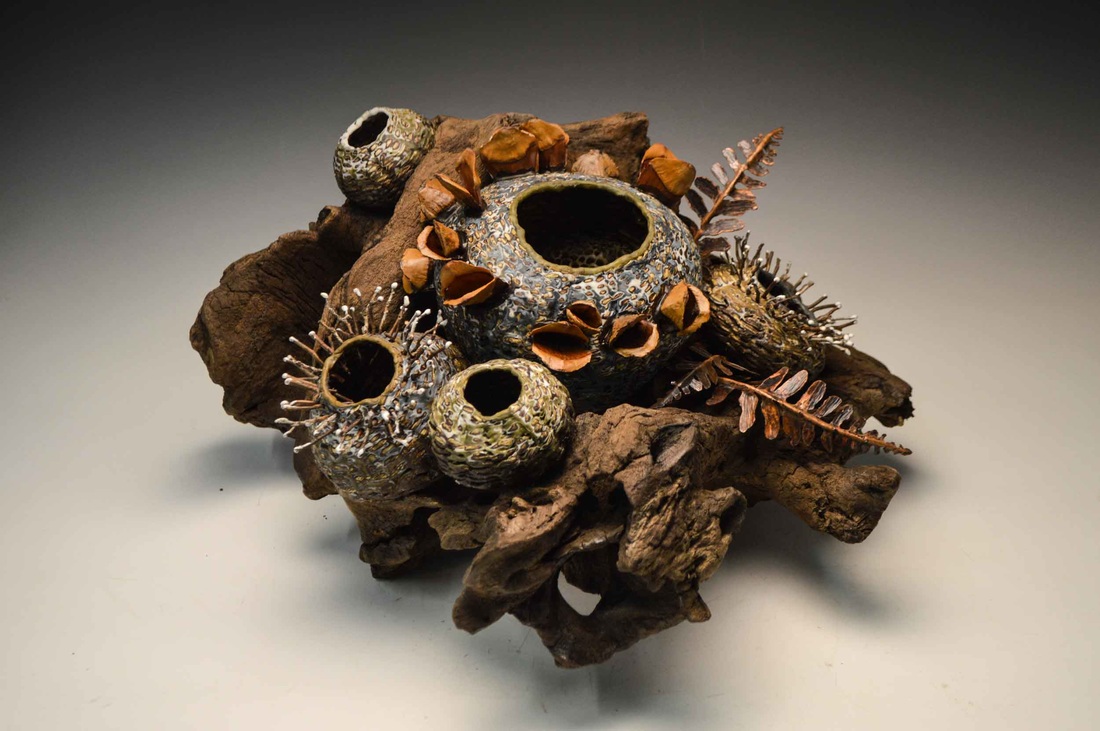
Sculptural collection in driftwood where encaustic was used to color and embed natural elements.
|
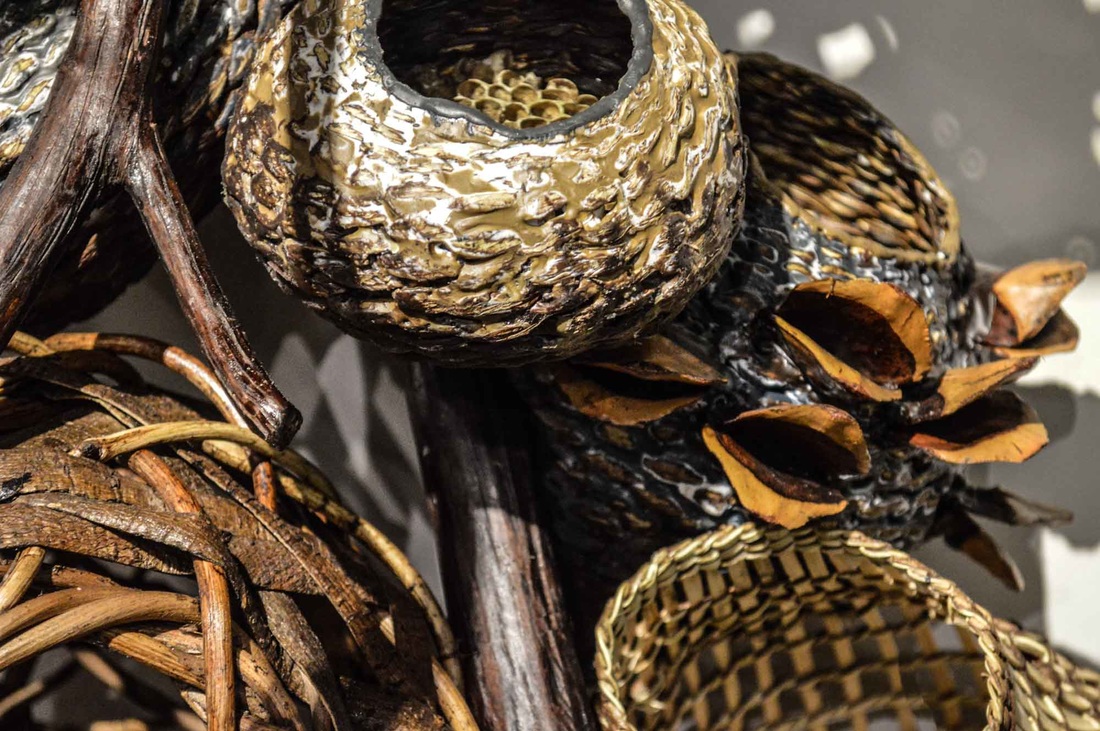
Closeup of a wall hanging where I used encaustic wax to color baskets and embed natural elements.
|
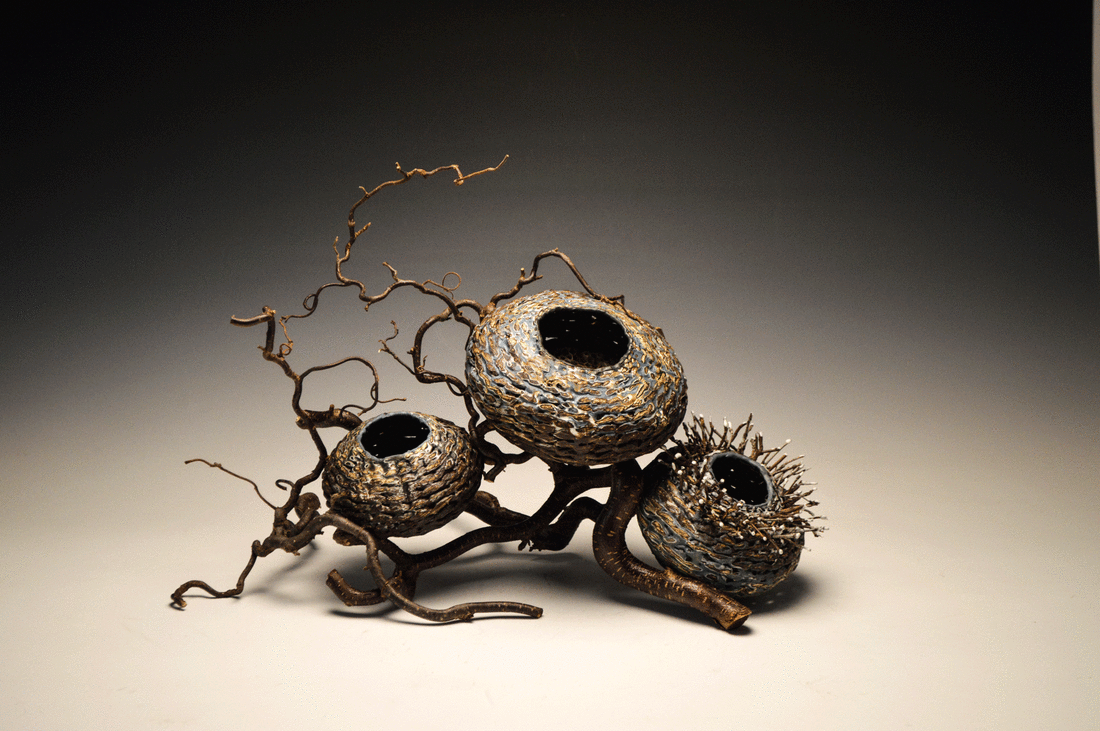
Sculptural baskets nested in Harry Lauder branches and covered in encaustic wax.
|
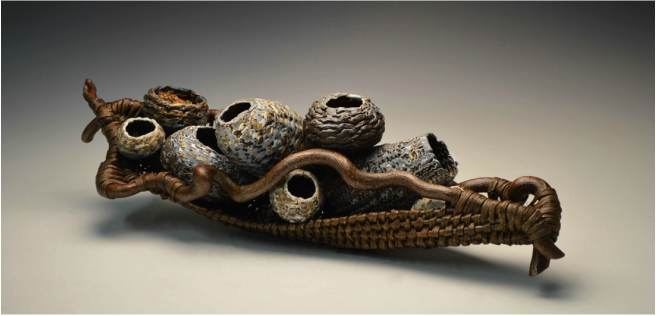
A collection of sculptural baskets covered in encaustic wax.
|
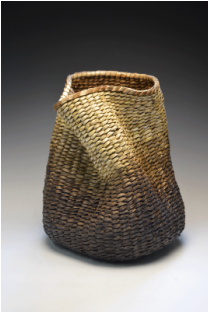
Natural fibers dyed and infused with clear encaustic medium.
|
Examples of Encaustic Wax Sculpture
I've used encaustic wax in my sculpture work for many years. It both preserves and accentuates my basket art, giving it a rich and ancient aesthetic that is desirable to many encaustic art fans.
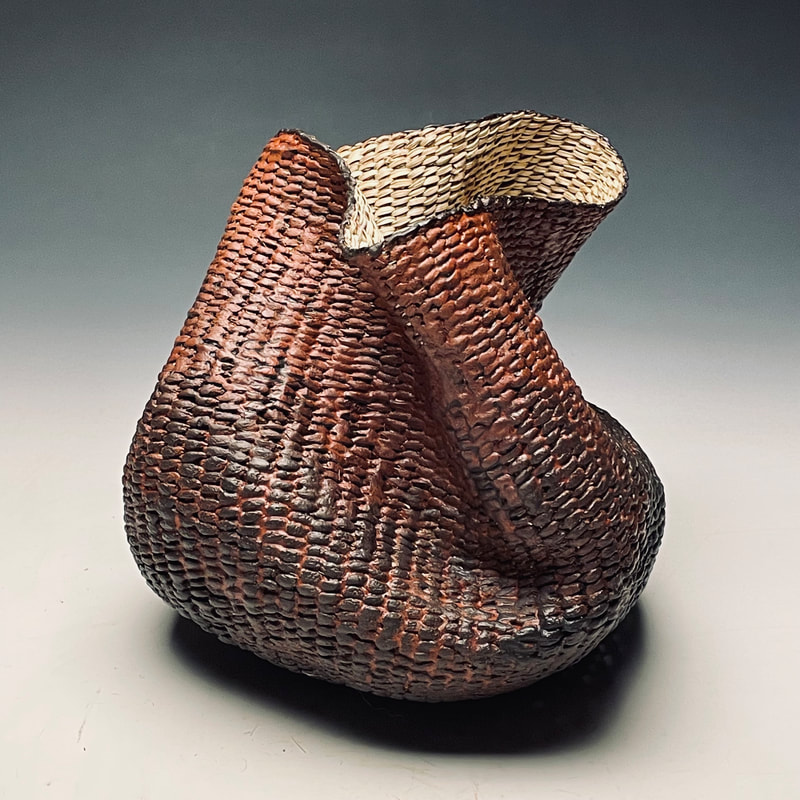
Encaustic Wax Sculpture with Freeform Basket
|
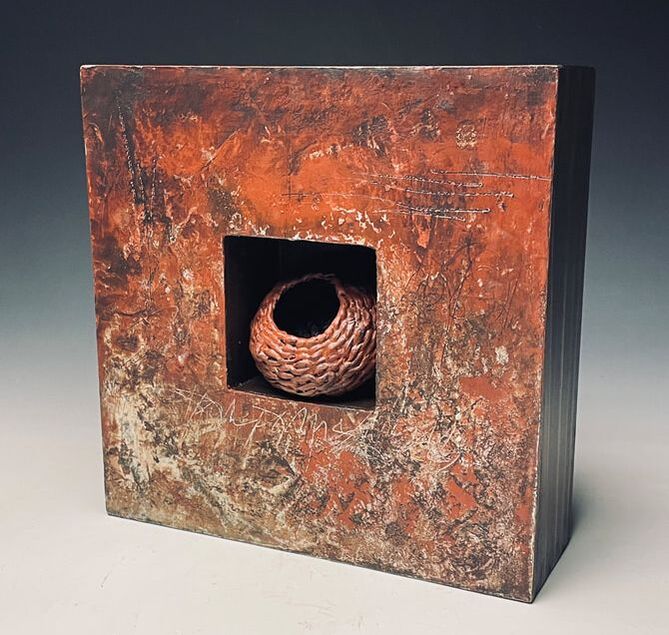
Encaustic Wax Sculpture with Basket and Panel
|
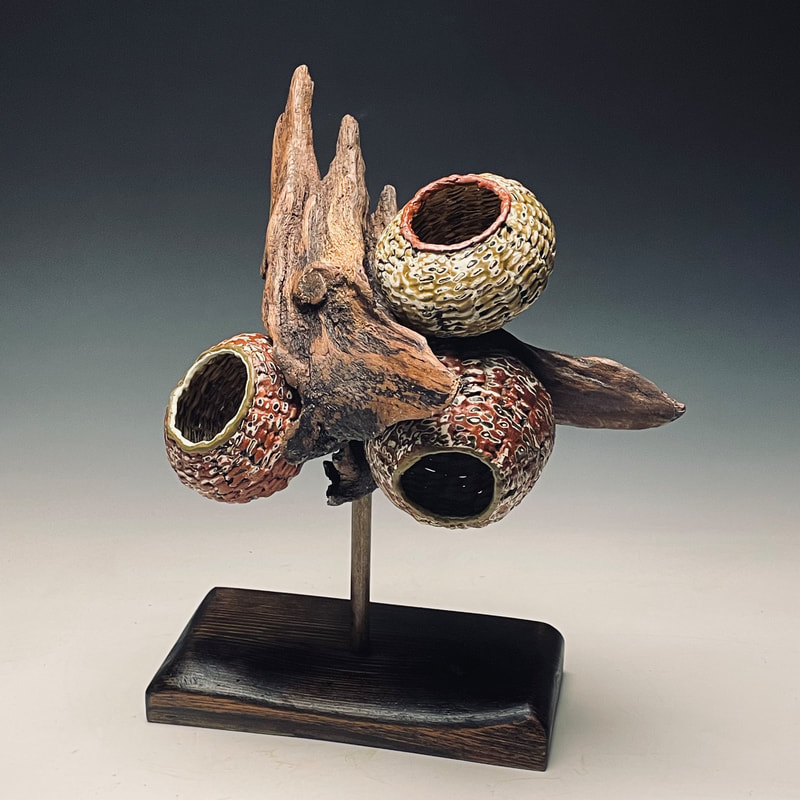
Encaustic Wax Sculpture with Baskets
|
Alternative Substrates for Encaustic Painting & Encaustic Sculpture
Encaustic painting offers artists the flexibility to explore various substrates beyond the traditional paper and wood surfaces. These alternative substrates present unique opportunities for creating captivating encaustic artwork. Some notable options include:
1. Canvas: Using a prepared canvas allows artists to bring the captivating texture and depth of encaustic to their paintings. Canvas can handle multiple layers of wax, creating a rich and intricate surface.
2. Ceramic: Bisque-fired ceramic serves as an interesting substrate for encaustic painting. The smooth and durable nature of ceramic can contrast with the organic and intricate qualities of wax, resulting in visually compelling pieces.
3. Drywall: Surprisingly, encaustic can be successfully applied to drywall, transforming an otherwise mundane and utilitarian surface into an artistic canvas. The porous nature of drywall allows the wax to adhere and absorb, adding a unique texture and visual depth.
4. Metal: Metal substrates, such as aluminum or copper panels, offer artists a distinctive and reflective background for their encaustic creations. The luminous quality of wax against these metallic surfaces can produce stunning effects.
5. Glass: While working directly on glass may not be ideal, artists can consider incorporating it into their encaustic pieces. By adhering or collaging wax-treated paper or other materials on glass, artists can achieve a transparent and layered effect.
6. Mixed Media: Encaustic can be combined with a wide range of materials, such as fabric, textured papers, and found objects, to create mixed media artwork. These materials can be mounted on a substrate like wood or canvas, allowing for endless possibilities and creative freedom.
7. Natural Fibers: Encaustic can be both infused into and layered on top of natural fibers for a beautiful and preservative finish that celebrates the texture of the fibers while offering the luminous beauty of encaustic wax.
Remember, one of the beauties of encaustic painting is the ability to experiment and explore different substrates. Artists can discover new techniques and effects by pushing the boundaries and trying out various materials to find what resonates with their artistic vision.
1. Canvas: Using a prepared canvas allows artists to bring the captivating texture and depth of encaustic to their paintings. Canvas can handle multiple layers of wax, creating a rich and intricate surface.
2. Ceramic: Bisque-fired ceramic serves as an interesting substrate for encaustic painting. The smooth and durable nature of ceramic can contrast with the organic and intricate qualities of wax, resulting in visually compelling pieces.
3. Drywall: Surprisingly, encaustic can be successfully applied to drywall, transforming an otherwise mundane and utilitarian surface into an artistic canvas. The porous nature of drywall allows the wax to adhere and absorb, adding a unique texture and visual depth.
4. Metal: Metal substrates, such as aluminum or copper panels, offer artists a distinctive and reflective background for their encaustic creations. The luminous quality of wax against these metallic surfaces can produce stunning effects.
5. Glass: While working directly on glass may not be ideal, artists can consider incorporating it into their encaustic pieces. By adhering or collaging wax-treated paper or other materials on glass, artists can achieve a transparent and layered effect.
6. Mixed Media: Encaustic can be combined with a wide range of materials, such as fabric, textured papers, and found objects, to create mixed media artwork. These materials can be mounted on a substrate like wood or canvas, allowing for endless possibilities and creative freedom.
7. Natural Fibers: Encaustic can be both infused into and layered on top of natural fibers for a beautiful and preservative finish that celebrates the texture of the fibers while offering the luminous beauty of encaustic wax.
Remember, one of the beauties of encaustic painting is the ability to experiment and explore different substrates. Artists can discover new techniques and effects by pushing the boundaries and trying out various materials to find what resonates with their artistic vision.
THe History of Encaustic Art
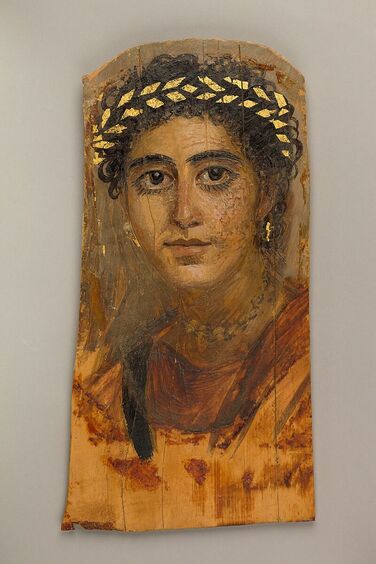 Ancient Funerary Portrait using Encaustic Wax from the Metropolitan Museum of Art
Encaustic art, a painting technique dating back to ancient times, is known for its lustrous color and enduring quality. The word "encaustic" comes from the Greek word "enkaustikos," which means to burn in, referring to the process of fusing the paint.
Origins and Ancient Techniques
Encaustic painting originated over 2000 years ago in ancient Greece. The Greeks primarily used encaustic for decorating warships and later for painting portraits and scenes. The most famous examples from this era are the Fayum mummy portraits from Egypt, which showcase the use of encaustic for funerary art in the 1st and 2nd centuries AD. These portraits illustrate the incredible durability of encaustic art; they still retain their vivid color today.
The Process
The unique process of encaustic painting involves using heated beeswax to which colored pigments are added. This liquid/paste is then applied to a surface—usually wood, though canvas can also be used. Metal tools and special brushes can shape the wax before it cools. The most crucial step in encaustic painting is the reheating of the wax to fuse the applied layers. This fusion creates a bond between the layers and gives the painting its characteristic depth and richness.
Damar Resin in Encaustic Painting
Damar resin plays a crucial role in encaustic painting, working in tandem with beeswax and either oil paint or natural powdered pigments to infuse vibrant color into the artwork. Derived from the sap of Dipterocarpaceae trees, damar resin is a natural substance that adds a glossy finish while elevating the melting point of the wax. When creating an encaustic medium, the resin is melted alongside beeswax at approximately 170 degrees Fahrenheit, forming a luscious, molten mixture known as hot paint. This concoction is then skillfully applied to a chosen surface, typically wood or canvas, resulting in the captivating textures and depth characteristic of encaustic paintings.
Beyond its significance in encaustic art, damar resin finds itself a versatile ingredient, finding use in an array of art supplies, incense, and even various culinary applications. The resin is extracted from the Dipterocarpaceae family of trees, predominantly found in East Asia, and undergoes a meticulous process of collection and air drying to attain its desirable properties.
In the realm of encaustic painting, artists often fine-tune the composition of their encaustic medium, experimenting with the ratio of damar resin to beeswax to achieve diverse effects. While a suggested ratio of 1 part resin to 8 parts wax is commonly employed, artists have the flexibility to tailor this ratio to their preferences, adjusting the hardness of the wax once it dries. This adaptability empowers artists to create works that align with their artistic vision, allowing for a personalized touch in the encaustic process.
It is worth noting that for those seeking convenience and ease, pre-mixed encaustic wax is readily available. However, for those who wish to immerse themselves in the art of encaustics and unleash their creativity to the fullest, the prospect of crafting their own encaustic paints presents a more cost-effective option in the long run.
In summary, damar resin, extracted from the sap of Dipterocarpaceae trees, serves as an essential component in encaustic painting, harmonizing with beeswax and pigments to infuse color and texture into artworks. Its glossy finish and ability to raise the melting point of wax elevate the art form, enabling artists to create captivating encaustic pieces. Furthermore, its versatility extends beyond encaustic painting, finding applications in a diverse range of art supplies, incense, and culinary delights. With the flexibility to adjust resin-to-wax ratios, artists can tailor their encaustic medium to their desired specifications. While pre-mixed options exist, the allure of crafting personalized encaustic paints beckons those seeking a more immersive artistic experience.
Decline and Resurgence
After the fall of the Roman Empire, encaustic fell into obscurity, largely because of the technique's labor-intensive process and the rise of tempera and oil painting. However, there was a significant resurgence of interest in encaustic art in the 20th century. This revival can be credited to the improved accessibility of materials and modern tools like electric heating devices, which make the process less cumbersome.
Modern Encaustic Art
Contemporary artists have embraced encaustic for its versatility and unique texture. Modern adaptations of the technique often incorporate collage elements, layering, and sculptural techniques. The medium allows for high degrees of manipulation, offering artists a broad range of surface treatments. The art form's ability to encapsulate materials, create translucency, and its capacity for both opaqueness and richness of color continues to attract artists.
Encaustic art, bridging a connection from the ancient world to the modern, stands out due to its tactile nature, depth of color, and durability. It's a testament to the enduring appeal of this ancient medium that contemporary artists still explore and expand its boundaries, ensuring that this ancient technique continues to evolve and inspire.
Origins and Ancient Techniques
Encaustic painting originated over 2000 years ago in ancient Greece. The Greeks primarily used encaustic for decorating warships and later for painting portraits and scenes. The most famous examples from this era are the Fayum mummy portraits from Egypt, which showcase the use of encaustic for funerary art in the 1st and 2nd centuries AD. These portraits illustrate the incredible durability of encaustic art; they still retain their vivid color today.
The Process
The unique process of encaustic painting involves using heated beeswax to which colored pigments are added. This liquid/paste is then applied to a surface—usually wood, though canvas can also be used. Metal tools and special brushes can shape the wax before it cools. The most crucial step in encaustic painting is the reheating of the wax to fuse the applied layers. This fusion creates a bond between the layers and gives the painting its characteristic depth and richness.
Damar Resin in Encaustic Painting
Damar resin plays a crucial role in encaustic painting, working in tandem with beeswax and either oil paint or natural powdered pigments to infuse vibrant color into the artwork. Derived from the sap of Dipterocarpaceae trees, damar resin is a natural substance that adds a glossy finish while elevating the melting point of the wax. When creating an encaustic medium, the resin is melted alongside beeswax at approximately 170 degrees Fahrenheit, forming a luscious, molten mixture known as hot paint. This concoction is then skillfully applied to a chosen surface, typically wood or canvas, resulting in the captivating textures and depth characteristic of encaustic paintings.
Beyond its significance in encaustic art, damar resin finds itself a versatile ingredient, finding use in an array of art supplies, incense, and even various culinary applications. The resin is extracted from the Dipterocarpaceae family of trees, predominantly found in East Asia, and undergoes a meticulous process of collection and air drying to attain its desirable properties.
In the realm of encaustic painting, artists often fine-tune the composition of their encaustic medium, experimenting with the ratio of damar resin to beeswax to achieve diverse effects. While a suggested ratio of 1 part resin to 8 parts wax is commonly employed, artists have the flexibility to tailor this ratio to their preferences, adjusting the hardness of the wax once it dries. This adaptability empowers artists to create works that align with their artistic vision, allowing for a personalized touch in the encaustic process.
It is worth noting that for those seeking convenience and ease, pre-mixed encaustic wax is readily available. However, for those who wish to immerse themselves in the art of encaustics and unleash their creativity to the fullest, the prospect of crafting their own encaustic paints presents a more cost-effective option in the long run.
In summary, damar resin, extracted from the sap of Dipterocarpaceae trees, serves as an essential component in encaustic painting, harmonizing with beeswax and pigments to infuse color and texture into artworks. Its glossy finish and ability to raise the melting point of wax elevate the art form, enabling artists to create captivating encaustic pieces. Furthermore, its versatility extends beyond encaustic painting, finding applications in a diverse range of art supplies, incense, and culinary delights. With the flexibility to adjust resin-to-wax ratios, artists can tailor their encaustic medium to their desired specifications. While pre-mixed options exist, the allure of crafting personalized encaustic paints beckons those seeking a more immersive artistic experience.
Decline and Resurgence
After the fall of the Roman Empire, encaustic fell into obscurity, largely because of the technique's labor-intensive process and the rise of tempera and oil painting. However, there was a significant resurgence of interest in encaustic art in the 20th century. This revival can be credited to the improved accessibility of materials and modern tools like electric heating devices, which make the process less cumbersome.
Modern Encaustic Art
Contemporary artists have embraced encaustic for its versatility and unique texture. Modern adaptations of the technique often incorporate collage elements, layering, and sculptural techniques. The medium allows for high degrees of manipulation, offering artists a broad range of surface treatments. The art form's ability to encapsulate materials, create translucency, and its capacity for both opaqueness and richness of color continues to attract artists.
Encaustic art, bridging a connection from the ancient world to the modern, stands out due to its tactile nature, depth of color, and durability. It's a testament to the enduring appeal of this ancient medium that contemporary artists still explore and expand its boundaries, ensuring that this ancient technique continues to evolve and inspire.
Encaustic Artists Whose Work I Enjoy
Several artists are renowned for their work with encaustic wax, including those creating encaustic wax sculptures. Some of the most notable contemporary artists in this medium are:
- Alicia Tormey: Alicia Tormey is an internationally recognized artist known for her botanical paintings, ethereal abstract landscapes, and pioneering encaustic techniques. (source)
- Helen Dannelly: Helen is a phenomenal artist, instructor, and encaustic sculptor. Love her work! (source)
- Shari Replogle: Shari Replogle is a mixed media artist and instructor born and raised in sunny California and now residing in the Midwest. I really enjoy her sculpture work. (source)
- Pamela Blum: Pamela makes sculptures and paintings with encaustic paint. Love her sculptural wall hangings. (source)
- Ruth Maude: Ruth is a Canadian encaustic painter and mixed media artist who does wonderful work in the Greater Toronto area. (source)
- Erin Keane: Erin is an artist working with photography, encaustic beeswax, and bookbinding. (source)
- Domenica Brockman and Kathleen Kvern are also notable for their contributions to encaustic art, each bringing their unique style and approach to the medium. (source)
- Lynda Benglis: Known for her work in various mediums, Lynda Benglis has also created notable pieces using encaustic wax. One of her works, "Embryo II" (1967), is a significant example of sculptural encaustic, displayed at the Museum of Modern Art (MOMA). (source)
- Martin Kline: His works "Nest" and "Target with Four Faces" are great examples of encaustic art that blurs the line between painting and sculpture, shown at The Metropolitan Museum of Art. (source, source)
- Jasper Johns: While not a contemporary artist, Jasper Johns is a significant figure in the history of encaustic painting. His works, such as "Target with Four Faces" (1955) and "White Flag" (1955), are pivotal in the art world and displayed in prestigious galleries like MOMA and The Metropolitan Museum of Art. (source)
- Julia Fosson: Julia's work in encaustic painting inspired Matt Tommey's initial exploration into the world of encaustic art. (source)
- Constance Williams: Constance is known for her large scale, contemporary encaustic paintings and also inspired Matt to pursue encaustic wax in his basketry work. (source)
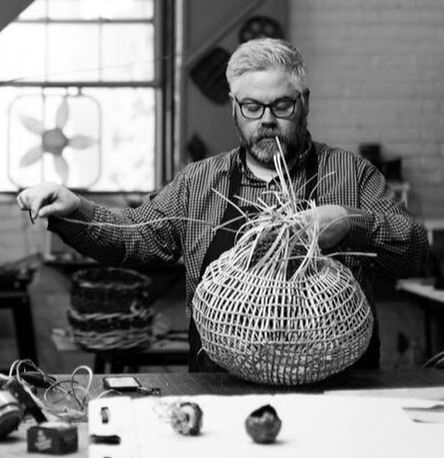 Encaustic Artist, Matt Tommey
Matt Tommey: Blending Basketry with Encaustic Art
Matt Tommey is widely recognized for his exceptional skills in basketry, an ancient craft that he has reinterpreted through a contemporary lens. His unique contribution to the art world lies in his incorporation of encaustic wax into his woven structures, creating pieces that are both visually striking and texturally rich.
Encaustic wax, a versatile medium, is meticulously melted and then deftly applied by Tommey. Whether it be a brush or any other tool that catches his artistic vision, he chooses the perfect instrument to bring his ideas to life. Layer by layer, the molten wax is carefully added to the woven materials, each subsequent layer reheated to ensure a seamless fusion with the previous one.
This harmonious combination of weaving and waxwork reveals Tommey's mastery of traditional basket-making techniques, seamlessly intertwined with the modern encaustic process. Through his skilled application of encaustic wax, he highlights the inherent beauty of the natural materials, creating a captivating interplay between the organic and the refined.
In this way, Tommey's art not only showcases his technical prowess but also provides a window into the intricate process of applying encaustic wax. With each stroke and reheating, he crafts a visual symphony, transforming humble materials into breathtaking masterpieces.
Innovations and Techniques
Tommey's work often involves the use of natural materials such as vines, branches, and barks, which he skillfully weaves into intricate baskets and sculptural forms. By applying encaustic wax to these creations, he adds an additional layer of texture and depth, further accentuating the organic beauty of the materials. This combination of weaving and waxwork showcases his ability to harmonize traditional basket-making techniques with the more modern encaustic process.
Artistic Philosophy and Recognition
Matt Tommey's work is deeply rooted in his appreciation of nature and its inherent beauty. His artistic philosophy revolves around the idea of finding the extraordinary in the ordinary, a concept that is vividly expressed through his unique creations. His innovative use of encaustic in basketry has not only garnered attention but also set him apart as a pioneering artist in this field.
Contributions to the Encaustic Art Community
Through his workshops and teachings, Tommey shares his knowledge and passion for both basketry and encaustic art, contributing significantly to the growth and evolution of these art forms. His work serves as an inspiration to both traditional crafters and contemporary artists, bridging the gap between different artistic disciplines and encouraging a more integrative approach to art-making. His work is included in the permanent collection of the Museum of Encaustic Art.
Matt Tommey's innovative use of encaustic in basketry has made a significant impact on the art community. His work exemplifies the creative possibilities that emerge when traditional crafts are infused with contemporary art practices, making him a notable figure in the world of encaustic art.
Matt Tommey is widely recognized for his exceptional skills in basketry, an ancient craft that he has reinterpreted through a contemporary lens. His unique contribution to the art world lies in his incorporation of encaustic wax into his woven structures, creating pieces that are both visually striking and texturally rich.
Encaustic wax, a versatile medium, is meticulously melted and then deftly applied by Tommey. Whether it be a brush or any other tool that catches his artistic vision, he chooses the perfect instrument to bring his ideas to life. Layer by layer, the molten wax is carefully added to the woven materials, each subsequent layer reheated to ensure a seamless fusion with the previous one.
This harmonious combination of weaving and waxwork reveals Tommey's mastery of traditional basket-making techniques, seamlessly intertwined with the modern encaustic process. Through his skilled application of encaustic wax, he highlights the inherent beauty of the natural materials, creating a captivating interplay between the organic and the refined.
In this way, Tommey's art not only showcases his technical prowess but also provides a window into the intricate process of applying encaustic wax. With each stroke and reheating, he crafts a visual symphony, transforming humble materials into breathtaking masterpieces.
Innovations and Techniques
Tommey's work often involves the use of natural materials such as vines, branches, and barks, which he skillfully weaves into intricate baskets and sculptural forms. By applying encaustic wax to these creations, he adds an additional layer of texture and depth, further accentuating the organic beauty of the materials. This combination of weaving and waxwork showcases his ability to harmonize traditional basket-making techniques with the more modern encaustic process.
Artistic Philosophy and Recognition
Matt Tommey's work is deeply rooted in his appreciation of nature and its inherent beauty. His artistic philosophy revolves around the idea of finding the extraordinary in the ordinary, a concept that is vividly expressed through his unique creations. His innovative use of encaustic in basketry has not only garnered attention but also set him apart as a pioneering artist in this field.
Contributions to the Encaustic Art Community
Through his workshops and teachings, Tommey shares his knowledge and passion for both basketry and encaustic art, contributing significantly to the growth and evolution of these art forms. His work serves as an inspiration to both traditional crafters and contemporary artists, bridging the gap between different artistic disciplines and encouraging a more integrative approach to art-making. His work is included in the permanent collection of the Museum of Encaustic Art.
Matt Tommey's innovative use of encaustic in basketry has made a significant impact on the art community. His work exemplifies the creative possibilities that emerge when traditional crafts are infused with contemporary art practices, making him a notable figure in the world of encaustic art.
Great Resources for Encaustic ARt
- AllThingsEncaustic.com
This is a great website with lots of links to resources and informative articles about encaustic art. Highly recommended.
- Museum of Encaustic Art & Encaustic Art Institute
The Encaustic Art Institute – a 501c3 – is celebrating its 17th year in operation. They feel fortunate to have remained on the leading edge of encaustic/wax art for artists and patrons alike. Their new business model of online activity and our ongoing online Encaustic Arts Magazine will continue to bring one of the oldest art media known to man to your doorstep.
Where to Find Encaustic Art Supplies
For artists interested in encaustic wax art, there are several excellent online stores where you can find a wide range of supplies. Here are some of the best places to shop for encaustic art supplies online as of 2024:
- The Encaustic Center: This store offers a variety of encaustic paints, including R&F Encaustic Paints and Enkaustikos Hot Sticks, along with blending sticks and iridescent colors. They also provide different series of handmade paints, catering to the specific needs of encaustic artists.
- Utrecht Art Supplies: Utrecht offers a range of encaustic painting supplies, including Enkaustikos Wax Snaps, R&F Encaustic Paints, encaustic mediums, gesso, damar resin, white beeswax, and tools like the Bella Tavola Mini Torch. They carry brands like Enkaustikos, R&F, and Bella Tavola, providing a variety of options for artists.
- Etsy: Etsy has a diverse selection of encaustic art supplies, including unique items like Moroccan/Encaustic style stencils, craft papers, and various tools for carving and shaping wax. Additionally, they offer a variety of encaustic paints and mediums, making it a great place to find both standard supplies and unique items for encaustic art.
- BLICK Art Materials: BLICK offers a comprehensive selection of encaustic mediums, including R&F Encaustic Impasto/Modeling Wax, Enkaustikos XD Wax Medium, pharmaceutical grade beeswax, pure beeswax, and various waxes for different purposes. They also provide Enkaustikos Damar Resin and other encaustic mediums in various forms, making it a one-stop-shop for encaustic artists.
Interested in Trying Out Encaustic Wax Painting and Encaustic Art?
To determine if encaustic painting is something you are interested in, there are a few steps you can take. First, you may not be ready to invest in all the necessary materials, considering the potential expense involved. In this case, you can start by purchasing a small block of beeswax, which can often be found at local farmer's markets from honey sellers.
Next, you can experiment with the beeswax using a blow dryer to gauge your level of inspiration and enthusiasm for the medium. Start by melting the beeswax down on the stove in an old pot, using a brush to apply it onto a finished piece. Then, use the blow dryer to fuse the wax onto the artwork.
By employing this simple technique, you can assess whether or not encaustic painting resonates with you. If you discover that you indeed enjoy working with beeswax, it may be time to invest in additional supplies such as a hot plate, heat gun, refined beeswax, and pigments. These tools will allow you to delve deeper into this captivating art form and explore its full potential.
If you're interested in using encaustic wax in basket weaving, please consider any of my basket weaving classes online which have a detailed bonus video on the use of encaustic wax in basketry.
Common Questions about Encaustic art
- How long does it take for the wax medium in encaustic art to cure and harden? The process of curing and hardening of the wax medium in encaustic art takes a period of approximately 1 to 3 years. Over this time, the wax continues to undergo transformation, gradually becoming fully cured and hardened.
- How should encaustic art be cared for? Encaustic art requires proper care to ensure its longevity and preservation. Although these paintings are highly archival, it is important to take certain precautions. Normal household conditions should not cause the work to melt, as the wax and resin used in encaustic art only melt at temperatures exceeding 150 degrees Fahrenheit. However, it is advisable to avoid leaving the painting in a hot car or hanging it in front of a window that receives direct and intense sunlight.
Furthermore, encaustic art is sensitive to freezing cold temperatures, so it should be protected from extreme cold conditions. Taking measures to maintain a stable and moderate temperature environment for encaustic paintings is crucial to prevent any potential damage.
Over time, some encaustic colors may develop a cloudy appearance, commonly known as "blooming." Fortunately, this issue can be easily resolved by gently rubbing the painting's surface with a soft cloth or nylon stocking. Doing so helps restore the distinctness and clarity of the image. It is worth noting that as the wax medium continues to cure and harden for a period of 1-3 years, the surface will gradually retain its desired glossy look.
In summary, caring for encaustic art involves protecting it from extreme temperatures, both hot and cold, and addressing any blooming issues through gentle rubbing. By following these guidelines, encaustic artworks can be maintained in optimal condition for years to come. - What are some notable examples of encaustic works from ancient times? Some significant examples of encaustic works from ancient times include the Fayum funeral portraits (link above), which were painted by Greek artists in Egypt during the 1st through 3rd centuries A.D. These portraits were created as memorials and placed over the mummified bodies of the deceased. Remarkably, these portraits are the only surviving encaustic works from ancient times. The vividness and freshness of the colors in these portraits have been attributed to the protection provided by the wax medium.